
Every utility we work with knows roughly what its non-revenue water figure is. Very few can say where it is going. That gap — between a headline percentage and an actionable location — is the whole problem, and it is a measurement problem long before it is a pipe-repair problem.
What non-revenue water actually is
Non-revenue water is the difference between the volume a utility puts into its distribution network and the volume it bills for. It has three components, and they need entirely different responses:
- Real losses — water that physically leaves the system through leaks, bursts and overflows. This is what most people picture, and it is usually the smallest actionable share in a network that has never been properly metered.
- Apparent losses — water that reaches a customer but is not billed correctly: meter under-registration, tampering, illegal connections, and billing that runs on estimates rather than reads.
- Unbilled authorised consumption — mains flushing, firefighting, and supply to institutions that are served but not invoiced.
The reason this taxonomy matters is that the interventions are unrelated. Real losses need pressure management and leak detection. Apparent losses need metering and a vending system. Chasing the first when your losses are mostly the second is how a utility spends a capital budget and moves nothing.
You cannot manage what you have not divided
A network-wide non-revenue water percentage is a scorecard, not a work instruction. To act on it you have to be able to say which part of the network is losing water, and that requires the network to be divided into hydraulically discrete zones — district metered areas, or DMAs.
A DMA is a section of the distribution network with a known and bounded number of inlets, each one metered. Close the boundary valves, meter the inlets, and the zone becomes an accounting unit: input volume in, billed volume out, and a difference you can put a crew on.
Practical sizing for a Nigerian urban network usually lands between 1,000 and 3,000 connections per zone. Smaller zones give you a sharper signal but multiply the boundary valves and inlet meters you have to buy and maintain. Larger zones are cheaper to instrument but the loss signal gets buried in normal demand variation.
The measurement that tells you the most
Minimum night flow. Between roughly 02:00 and 04:00, legitimate consumption in a residential zone falls to a predictable floor. Whatever is still flowing into the zone above that floor is, with reasonable confidence, leakage. Track minimum night flow per DMA over time and you have a leakage trend per zone that updates nightly, without a single person walking the network with a listening stick.
This is why the inlet meter matters more than almost anything else you install. It needs to log at a useful interval — 15 minutes or better — and it needs to be accurate at low flow, which is precisely where mechanical meters are least accurate. Electromagnetic and ultrasonic meters hold their accuracy across a much wider turndown, which is why they dominate DMA inlets.
Instrumenting a live network without shutting it off
The objection we hear most often is practical: the network is in service, the customers are already unhappy, and a planned outage to install a bulk meter is politically expensive.
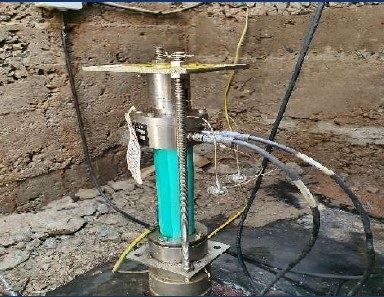
It is avoidable. Full-profile insertion electromagnetic flow meters are installed by hot-tapping — a tapping valve and drilling machine mounted on the live main, the sensor inserted under pressure, the converter mounted and wired, and calibration verified, all without interrupting supply. We have installed these on Lagos trunk mains with the water still flowing.
Insertion meters are also considerably cheaper to install than a full-bore meter on a large-diameter main, because there is no pipe cutting, no spool piece and no crane. On a 600mm trunk main the difference in installed cost is not marginal.
Then, and only then, the customer meter
Once a zone's input is measured, its output has to be measured too, or the calculation has no second term. This is where prepaid ultrasonic metering earns its place — not primarily because it improves collection, though it does, but because it converts a zone from estimated billing to measured billing and makes the loss figure real.
Ultrasonic meters matter here for a specific reason: no moving parts. A mechanical meter's accuracy degrades as its measuring element wears, and it degrades in one direction — under-registration. A fleet of ageing mechanical meters produces a quiet, growing apparent loss that looks exactly like leakage on a balance sheet and is not.
Across Lagos Water Corporation schemes we configured and installed more than 15,900 domestic and bulk prepaid ultrasonic meters, plus 110 bulk meters and 6 zonal meters. The single most useful thing that programme produced was not the revenue — it was that entire zones stopped being estimates.
A workable order of operations
- Define the zones. Hydraulic modelling and valve surveys to establish where the network can actually be divided. This is desk and field work, not procurement.
- Meter the inlets. Electromagnetic or ultrasonic bulk meters with data logging, hot-tapped where an outage is unacceptable.
- Establish the baseline. Run the zone for a few weeks and record minimum night flow before changing anything, or you will have no way to prove what the intervention achieved.
- Meter the customers. Prepaid ultrasonic metering with a vending platform, deployed zone by zone rather than scattered across the network.
- Close the loop. Analytics that compare input against billed consumption per zone, flag zones whose night flow is climbing, and put crews where the numbers point.
The order matters. Utilities that start at step four — because customer meters are the visible, fundable part — end up with a large meter fleet and still no idea where the water is going.
What this looks like in practice
Flant Automations delivers all five steps: the bulk and zonal instrumentation, the hot-tap insertion, the domestic prepaid metering, the connectivity and the analytics layer that turns telemetry into leak signatures and demand profiles. If you are at step one and wondering what to instrument first, that is a conversation worth having before the procurement is written rather than after.
Related
Working on something this touches?
We would rather have the conversation before the specification is written than after.